
Your cart is currently empty!
Children are naturally curious about animals. They enjoy watching fish swimming in water, dolphins jumping in the sea, or turtles moving slowly near the shore. Because animals are interesting and easy to recognize, they are often one of the first topics children enjoy learning about.
Today many children in Gujarat study in English medium schools. They quickly learn English words from books, cartoons, and classroom lessons. However, parents often notice that their children are not very familiar with Gujarati vocabulary, especially when it comes to everyday topics like animals.
Learning water animals names in Gujarati and English (જળચર પ્રાણીઓ ના નામ ગુજરાતી અને અંગ્રેજીમાં) can help children understand both languages at the same time. It allows them to build vocabulary in English while also staying connected with their regional language, Gujarati.
Teaching simple topics like animals is a good way to begin bilingual learning because children already enjoy talking about animals and remembering their names.
Why Learning Gujarati Vocabulary Is Important for Kids
Gujarati is not only a language but also an important part of culture and everyday communication. Even if children study in English medium schools, many conversations at home still happen in Gujarati.
When children learn basic Gujarati words, they can communicate easily with grandparents and relatives who prefer speaking Gujarati. It also helps them understand Gujarati stories, songs, and books as they grow older.
Learning two languages at an early age also helps improve memory and thinking skills. When children know both the English and Gujarati name of an object or animal, their brain naturally connects the two words together. This strengthens language development.
For this reason, many parents like to teach their children simple vocabulary in both languages. Topics like animal names in Gujarati (પ્રાણીઓ ના નામ) or water animals names in Gujarati (જળચર પ્રાણીઓ ના નામ) are a great place to start.
What Are Water Animals?
Water animals are animals that live mainly in water environments such as oceans, seas, rivers, and lakes. These animals are also called aquatic animals (જળચર પ્રાણી) because water is their natural habitat.
Different water animals have special features that help them live and move easily in water. Fish have fins and tails that help them swim smoothly. Dolphins and whales have strong bodies that allow them to travel long distances in the ocean.
Some animals breathe through gills, while others come to the surface to breathe air. For example, dolphins and whales are mammals, so they breathe oxygen from the air even though they live in water.
There are also animals like turtles and crocodiles that spend time both in water and on land. These animals are sometimes called semi-aquatic animals because they live in both environments.
Learning about these animals helps children understand how different creatures adapt to their surroundings.
Why Water Animals Are Interesting for Preschool Kids
Water animals are fascinating because they live in a world that children cannot easily see every day. Oceans and seas contain many unusual creatures that look very different from land animals.
For example, whales (વ્હેલ) are the largest animals on Earth. They travel across huge oceans and communicate using deep sounds. Dolphins (ડોલ્ફિન) are known for their intelligence and playful behavior. They often swim in groups and jump above the water surface.
Sharks (શાર્ક) are powerful swimmers with sharp teeth. Even though movies sometimes show them as dangerous, they are simply part of the ocean’s natural ecosystem.
Other animals like starfish (તારા માછલી), jellyfish (જેલીફિશ), and crabs (કરચલો) have unique shapes that make them interesting for children to observe and learn about.
When children learn the names of these animals, they also become curious about oceans, rivers, and the natural world.
Visual Learning Helps Kids Remember Faster
Young children learn best when they see pictures along with words. A visual image helps the brain connect the name of an animal with how it looks.
For example, when a child sees a picture of a dolphin and reads Dolphin – ડોલ્ફિન, the brain quickly remembers the connection between the animal and its name.
Because of this, teachers often use posters, charts, and flashcards in preschool classrooms. These visual tools make learning enjoyable and help children remember vocabulary naturally.
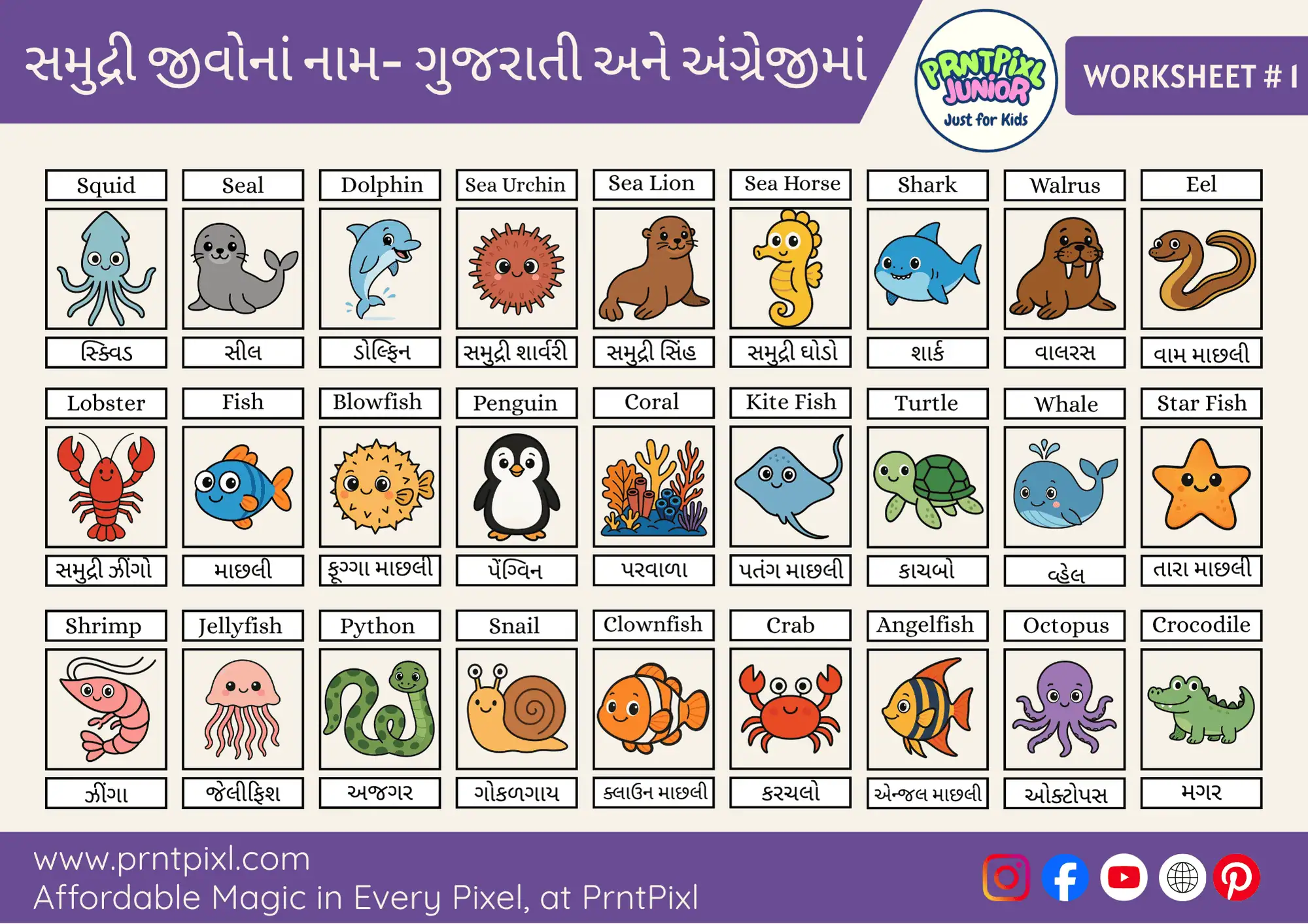
Water Animals Learning Poster
One of the easiest ways to introduce water animals names in Gujarati and English (જળચર પ્રાણીઓ ના નામ) is through a learning poster. A poster displays many animals together with their names, making it easier for children to recognize them.
When children see the same poster regularly, they slowly begin to remember the names without feeling like they are studying.
Parents can place a learning poster:
- near the child’s study desk
- on a classroom wall
- in a play area where children spend time
Repeated exposure to the pictures helps children recall the names easily.
Types of Water Animals Children Can Learn About
The oceans and rivers are home to a wide variety of animals. Some are large and powerful, while others are small and delicate. Each animal has its own unique features.
Fish are the most common aquatic animals. They use fins and tails to swim through water. There are thousands of species of fish living in oceans, lakes, and rivers.
Animals like octopus (ઓક્ટોપસ) and squid (સ્ક્વિડ) are known for their intelligence and ability to move quickly in water. Octopuses can even change color to hide from predators.
Sea turtles (કાચબો) travel long distances across the ocean and often return to the same beaches where they were born. Creatures like coral (પરવાળા) and sea urchins live on the ocean floor and create important habitats for other marine life.
Learning about these animals helps children understand that oceans and rivers contain many different forms of life.
Water Animals Names in Gujarati and English
Below is a list of common water animals names in Gujarati and English that children can learn easily.
| English Name | Gujarati Name |
|---|---|
| Squid | સ્ક્વિડ |
| Seal | સીલ |
| Dolphin | ડોલ્ફિન |
| Sea Urchin | સમુદ્રી શાવરી |
| Sea Lion | સમુદ્રી સિંહ |
| Sea Horse | સમુદ્રી ઘોડો |
| Shark | શાર્ક |
| Walrus | વાલરસ |
| Eel | વામ માછલી |
| Lobster | સમુદ્રી ઝીંગા |
| Fish | માછલી |
| Blowfish | ફુગ્ગા માછલી |
| Penguin | પેંગ્વિન |
| Coral | પરવાળા |
| Kite Fish | પતંગ માછલી |
| Turtle | કાચબો |
| Whale | વ્હેલ |
| Starfish | તારા માછલી |
| Shrimp | ઝીંગા |
| Jellyfish | જેલીફિશ |
| Python | અજગર |
| Snail | ગોકળગાય |
| Clownfish | ક્લાઉન માછલી |
| Crab | કરચલો |
| Angelfish | એન્જલ માછલી |
| Octopus | ઓક્ટોપસ |
| Crocodile | મગર |
Final Thoughts
Learning water animals names in Gujarati and English (જળચર પ્રાણીઓ ના નામ) is a simple and enjoyable way to help preschool children build vocabulary in two languages. It helps them understand animals while also strengthening their connection with Gujarati.
Animals like dolphins, whales, turtles, and starfish naturally attract children’s attention. When these animals are introduced through pictures, posters, and everyday conversations, children remember their names more easily.
Small learning activities at home can make a big difference in language development. By introducing interesting topics like water animals, parents can help children learn Gujarati vocabulary in a natural and enjoyable way.
Leave a Reply